top of page


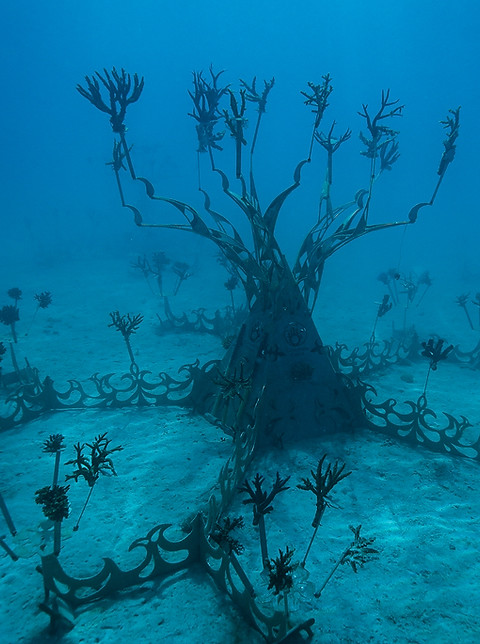
Castaway Island, nestled on Fiji’s breathtaking Qalito Island, is Counting Coral’s newest partner and dedicated steward of coral restoration. As of June 2025, it proudly hosts a large Sculptural Coral Gene Bank and has taken a major step toward establishing an active, large-scale restoration system for the island. Driven by a bold vision, and brought to life by a passionate community of ocean advocates, this project proves that restoration can be as innovative as it is essential.
With the incredible support of Castaway Island, Fiji Resort, and the Outrigger Hotel Group, we have launched a large-scale, awe-inspiring project—an initiative of sculptural, living creations born from bold innovation and designed to drive real transformation within the reefs. This is Counting Coral's third, full-scale Sculptural Coral Gene Bank in Fiji. Designed over six months in California and constructed from marine-grade stainless steel, this striking structure is home to over 500 parent corals.

The Gene Bank was designed, engineered, and manufactured by Counting Coral in Los Angeles, California over a six-month development period. Its design followed an on-site ecological and topographical survey at Castaway Island, where key environmental factors, such as topography, nutrient flow, temperature stability, reef proximity, and hydrodynamic exposure were assessed to determine placement and design of the Gene Bank.
At the core of the Gene Bank is a central feature composed of a sculptural, tree-like framework. This architectural form places genetically valuable corals in close yet intentionally staggered proximity, optimizing both growth potential and spatial independence. Each coral position within the entire park is systematically tagged and cataloged to support precise monitoring and data collection.
The Gene Bank also incorporates removable stanchions, providing the flexibility to adjust coral depth, relocate segments within the site, or remove units entirely if needed. Multiple elevation tiers across the park allow researchers to evaluate coral performance at varying heights and microhabitats within the Gene Bank.Together, the surveillance strategy, structural engineering, and spatial design create a resilient, adaptable, and scientifically rigorous framework for long-term coral conservation and propagation.
The Gene Bank houses a curated collection of genetically diverse and potentially resilient corals. These corals are sourced either as opportunistic fragments or taken from larger, healthy colonies identified by both the research team and local partners as exhibiting strong diversity and stress tolerance.
A defining feature of this system is that all parent colonies remain permanently within the restoration park. By keeping these corals in place, we can conduct ongoing monitoring, performance tracking, and resilience assessments under natural environmental conditions. Once individual corals demonstrate stable, resilient traits, they are selectively fragmented and cloned for transfer to secondary nurseries, and ultimately, for outplanting onto the reef. This approach prevents the loss of valuable genetic material by avoiding premature out-planting and instead maximizing each coral’s propagation potential. Through clonal replication, multiple genetically identical fragments can be produced from a single high-performing colony, significantly increasing the impact of each resilient genotype.


Inside the Gene Bank
at Castaway Island, Fiji
.jpg)
The Gene Bank at Castaway, consistent with all Counting Coral projects houses a selectively curated assemblage of coral species. Priority is placed on colonies that are rare within the area, those demonstrating indicators of bleaching resilience for continued assessment, and corals displaced from the reef that require secure reattachment to survive.
Branching corals form the core of the collection due to their structural complexity, ecological value, and strong performance in propagation and restoration. Plating species are incorporated when appropriate to increase habitat diversity and support ecosystem resilience. Soft corals are seldom maintained because of the challenges associated with attachment and propagation; however, a limited number are rescued when dislodged from the reef.
We employ marine-grade stainless steel wire to complement the structural design and provide the safest, most stable substrate for coral attachment and overgrowth. Corals are shaped and positioned to fit the stanchion style being used, with different stanchion designs available to suit various coral shapes—some standing upright and others sitting low or flat.
For successful attachment, viable living tissue must make direct contact with the steel at multiple points. Using a controlled twist-and-tighten technique, each fragment is secured to the stanchion with stainless steel wire, ensuring firm placement while minimizing stress to the coral. Over time, the coral naturally grows over, adheres to, and fully encloses the wire and stanchion surface without risk of toxicity.

Castaway Island needs Secondary Coral Nurseries to complete the full restoration cycle. In 2026, the next phase of work involves installing nursery tables on the island, enabling us to fragment the parent animals currently growing in the Gene Bank, clone these resilient specimens, cultivate them , and ultimately out-plant them onto the reef.
To advance this critical stage of the project, we are actively fundraising to bring the necessary nursery infrastructure to Castaway. Your support is essential to making this progression possible. We invite you to join us in this mission to restore and protect the reef.


bottom of page